Your First Launch
The first time you open Private Passwords, the Welcome asks a few quick questions, then gives you a short tour. It takes a couple of minutes.
The questions
Where are your passwords kept?
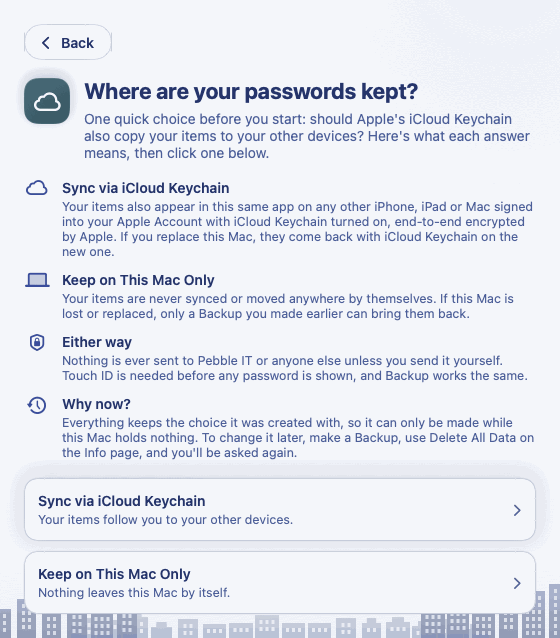
Click one:
- Sync via iCloud Keychain. Your items also appear in Private Passwords on your iPhone, iPad or other Mac signed into the same Apple Account, with iCloud Keychain turned on. Apple encrypts them end to end. If you replace your Mac, they come back on the new one.
- Keep on This Mac Only. Your items never leave this Mac by themselves. If it's lost or replaced, only a backup you made earlier can bring them back.
Either way, nothing is ever sent to Pebble IT or anyone else unless you send it yourself.
Choose carefully
Everything you keep remembers the choice it was made with, so you can only choose while Private Passwords is empty. To change it later you'd make a backup, use Delete All Data on the Info page, and answer again.
Is Private Passwords already on another of your devices?
You're asked this if you chose iCloud Keychain.
- No, this is my first. Private Passwords sets up its starter templates on this Mac.
- Yes, on another device. Nothing is set up here. Your items, templates and tags arrive from your other device, usually within a minute.
Your templates
Choose your country. Templates then use the names your country uses, such as Postcode or ZIP code, and BSB or Sort code. Dates are typed and shown the way your country writes them. You can rename any label later, and change how dates look in Settings.
Already using Private Passwords on your iPhone?
If your iPhone's items have already arrived on this Mac through iCloud Keychain, there's nothing to ask: the Mac uses them, and the Welcome goes straight to the tour.
The tour
Ten short pages show you around, most with moving pictures of each step. Click Next to move on, Back to go back, or Cancel to skip the rest.
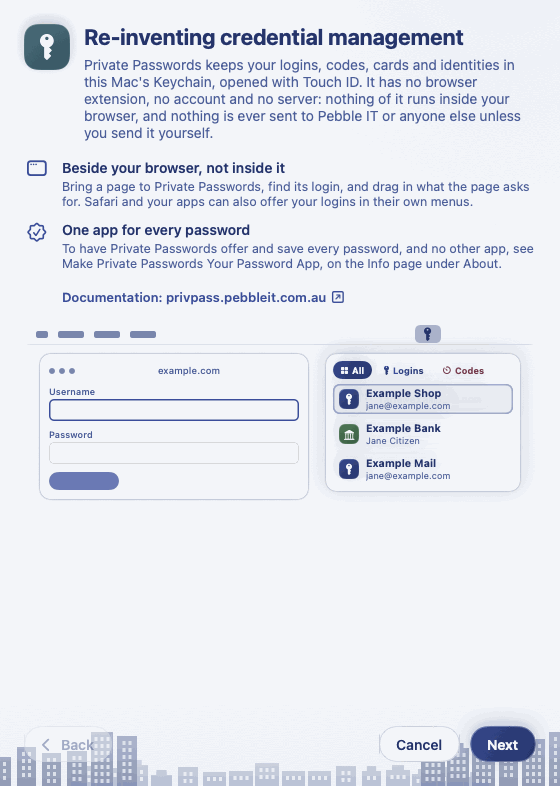
- Re-inventing credential management: what Private Passwords is, and that nothing of it runs in your browser.
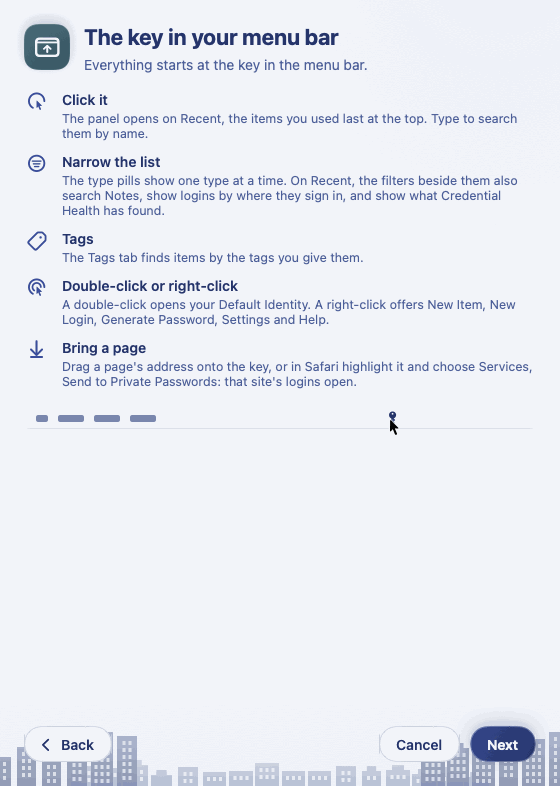
- The key in your menu bar: clicking, double-clicking and right-clicking the key, and bringing a page to it.
- Signing up with your identity: dragging your details into a sign-up form, and keeping a new password.
- AutoFill in Safari and apps: your logins and codes offered in their own menus, after Touch ID.
- Site Check: showing Private Passwords the page you're on, before you hand over a password.
- One-time codes: adding a code, copying or dragging it, and AutoFill offering it.
- Make it yours: themes, Touch ID, the panel and copying, in Settings.
- Your other Apple devices: how syncing with iCloud Keychain works.
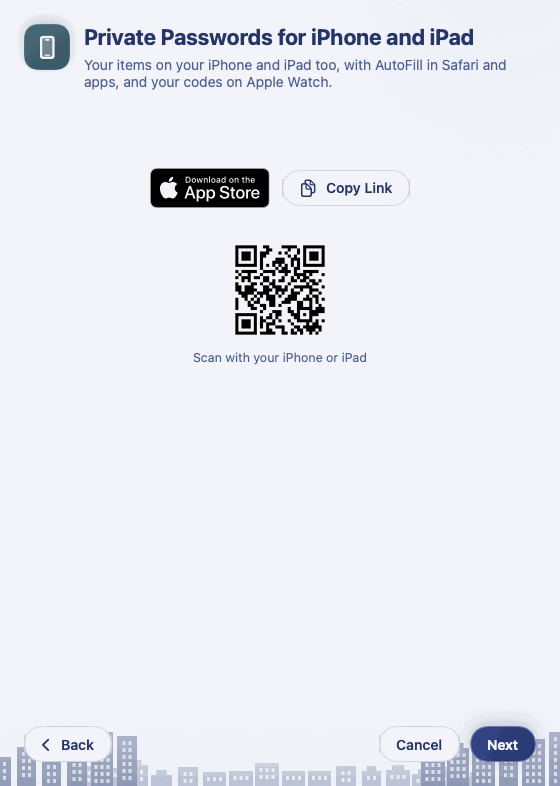
- Private Passwords for iPhone and iPad: the app for your iPhone, with its App Store badge, Copy Link, and a QR code to scan with your iPhone's camera.
- Begin with your identity: why your identity comes first, setting it up, and then adding your logins.
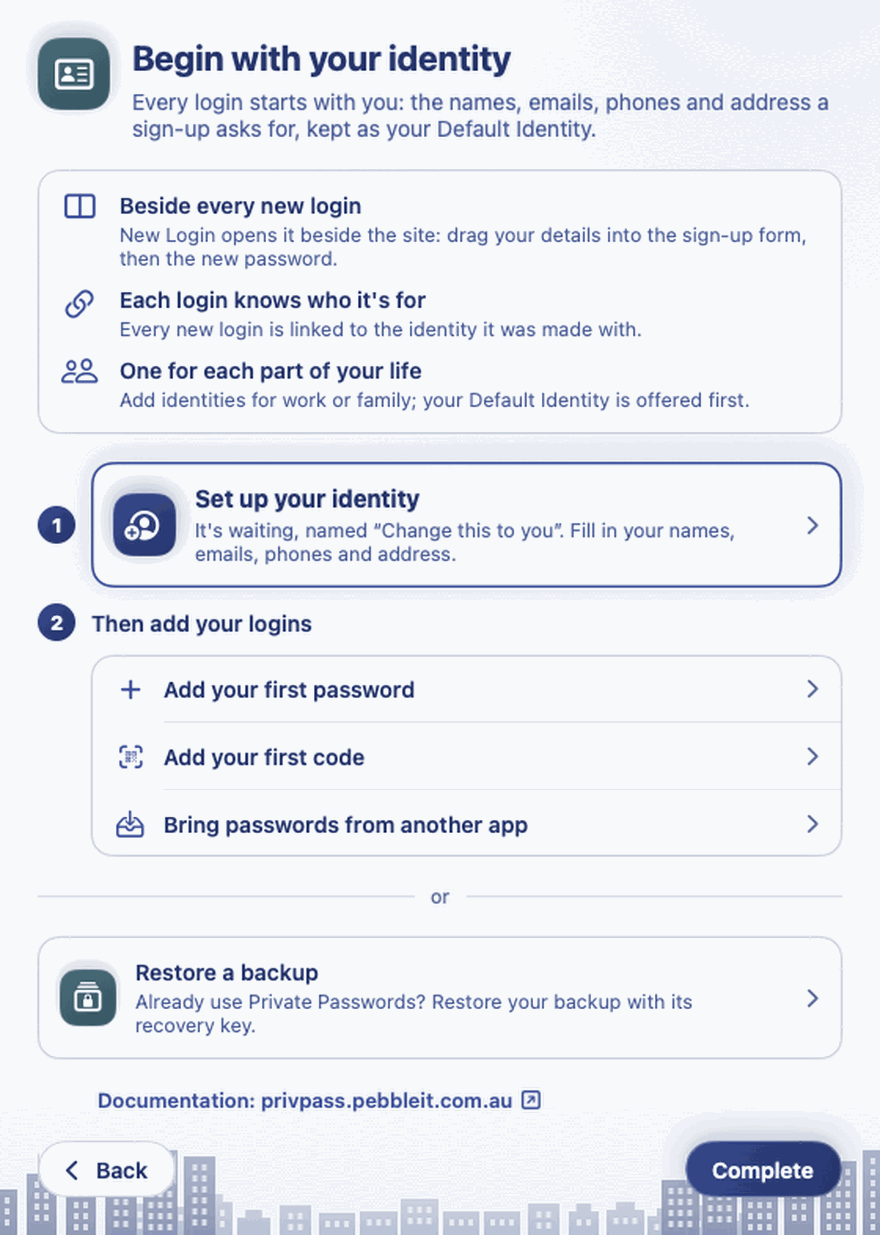
The last page asks you to set up your identity first: the names, emails, phones and address a site asks for when you sign up. Click Set up your identity to fill it in. Then add your logins: click Add your first password, Add your first code, or Bring passwords from another app to import them. If you already use Private Passwords, click Restore a backup instead.
Or click Complete to start using the app.
Seeing the tour again
The tour is always there: click the key, then Info, and click Welcome to Private Passwords under About or under Help.
The key in your menu bar
Everything starts at the key at the top right of your screen:
- Click it to open the panel, on Recent.
- Double-click it to open your Default Identity.
- Right-click it for New Item, New Login, Generate Password, Settings, About Passkeys, Help, Close Windows and Quit.
Your starter identity
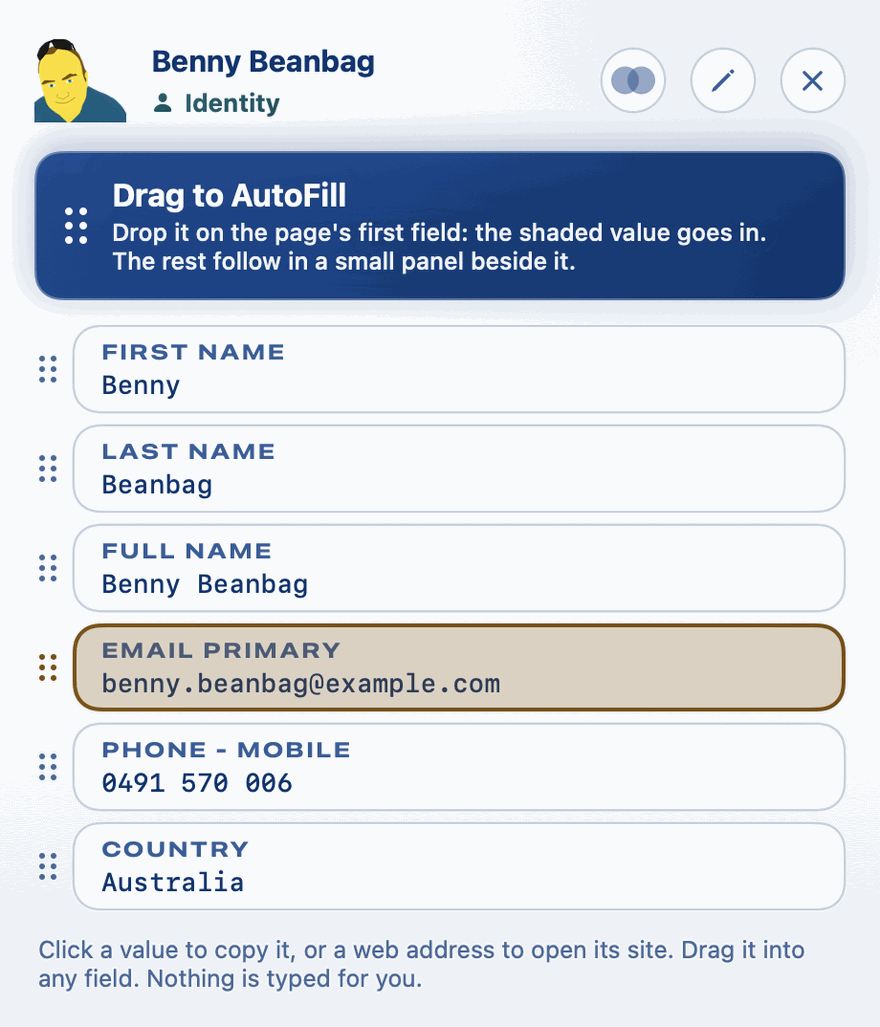
Private Passwords makes one identity for you to start with, named Change this to you. It's your Default Identity, the one offered whenever you make a new login. Open it and fill in your own names, emails, phones and address. See Identities.
Touch ID or your password
Private Passwords asks for Touch ID before it shows a password or opens an item. Where Touch ID isn't available, it asks for your Mac's login password. Once you've confirmed, it stays open for a while without asking again. You can choose how long in Touch ID, Your Password and the unlock period.